How to Spot a Fake Google Review (and What to Do)
A suspicious Google review can be frustrating, especially when you cannot match the reviewer to a real customer, transaction, appointment, or interaction with your business.
But a review being unfamiliar does not automatically mean it is fake.
The best approach is to look for specific warning signs, document what you can verify, and compare the review against Google’s content policies before deciding whether to challenge it.
If you're already wondering whether a questionable review may qualify for removal, see our guide to what makes a Google review eligible for removal.
Quick Answer: How Can You Tell If a Google Review Might Be Fake?
Common warning signs include:
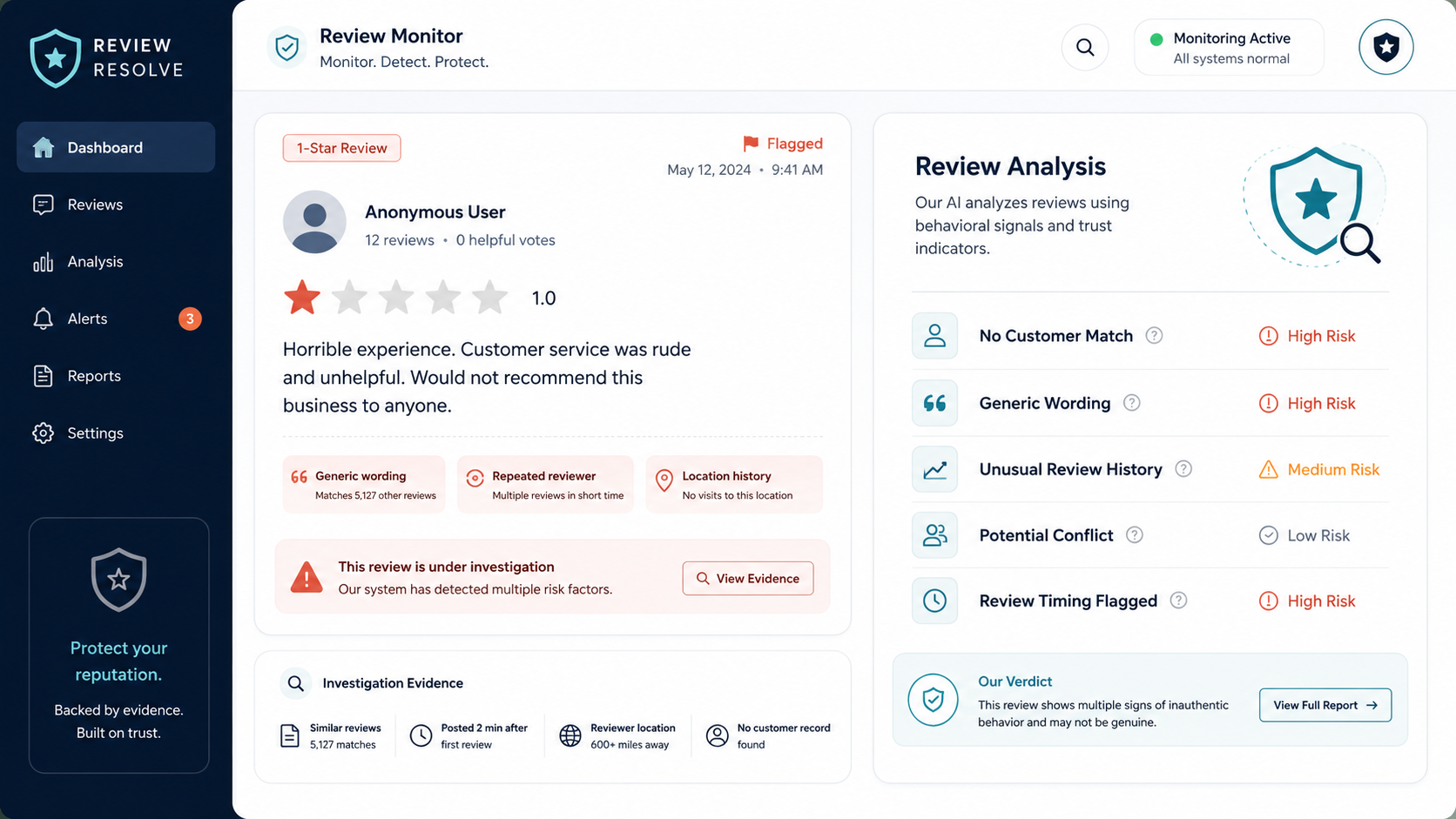
- No record of the reviewer in your customer or booking system
- Generic wording that could apply to almost any business
- A reviewer profile showing similar complaints across unrelated businesses or cities
- Multiple suspicious reviews appearing within a short period
- Details that conflict with your actual services, staff, location, or business practices
- Timing that coincides with a dispute, former employee issue, or competitor activity
- A review that appears unrelated to a genuine customer experience
None of these signs alone proves a review is fake.
They are reasons to investigate further.
What Does Google Consider a Fake Review?
Google's review policies are intended to keep contributions tied to genuine experiences.
Content may violate Google's policies when it involves issues such as:
- Fake engagement
- Reviews that do not reflect a genuine experience
- Conflicts of interest
- Competitor manipulation
- Certain employee-related conflicts
- Impersonation
- Misrepresentation
- Off-topic content
A negative review is not removable simply because the business disagrees with it.
The more useful question is:
Does the review appear to violate Google's policies?
For a broader explanation of the distinction, visit our What Reviews Qualify? guide.
7 Signs a Google Review May Be Fake
1. You Cannot Find the Reviewer in Your Records
Start with your own systems.
Search:
- Customer records
- CRM
- Reservations
- Appointments
- Orders
- Invoices
- Support tickets
- Phone records
- Email records
If you cannot find any interaction that resembles the review, document that.
However, keep in mind that people sometimes use a different Google account name than the name used during a transaction.
So a missing name is a warning sign, not definitive proof.
2. The Review Is Extremely Generic
Suspicious or low-quality reviews sometimes use vague statements such as:
- "Terrible service."
- "Worst company ever."
- "Stay away."
- "Very unprofessional."
A short review can still be completely legitimate.
But generic language becomes more suspicious when combined with other inconsistencies.
For example, a review that makes broad accusations without mentioning:
- A product
- A service
- An employee
- A date
- A location
- Any specific interaction
may deserve closer examination.
3. The Details Do Not Match Your Business
Sometimes a review describes something your company simply does not offer.
Examples might include:
- Mentioning a service you do not provide
- Naming an employee who has never worked there
- Describing a location that does not exist
- Referring to policies your company does not have
- Describing an interaction that could not have occurred
These inconsistencies can be useful documentation when evaluating whether the review reflects a genuine experience.
4. The Reviewer Has a Suspicious Review History
Look at the reviewer's public Google profile when available.
Potential warning signs include:
- Reviewing many unrelated businesses in different cities over a short period
- Posting repeated 1-star reviews
- Using nearly identical wording across businesses
- Reviewing competing businesses in unusual patterns
- Posting reviews across locations that would be difficult to visit within the timeframe shown
Again, none of these automatically proves a review is fraudulent.
But the broader pattern can provide useful context.
5. Several Negative Reviews Arrive at Once
A sudden cluster of negative reviews can sometimes indicate coordinated activity.
For example:
Your business normally receives a few reviews each month.
Then five 1-star reviews appear within 24 hours.
That should prompt further investigation.
Check whether:
- The accounts appear related
- The language is similar
- The reviews reference the same issue
- A recent dispute may have triggered the activity
- The reviewers appear connected
Coordinated review activity may be especially important when the reviewers do not appear to be genuine customers.
6. The Timing Lines Up With a Dispute or Conflict
Timing can provide important context.
For example, a suspicious review may appear shortly after:
- An employee termination
- A vendor dispute
- A competitor conflict
- A customer disagreement
- A legal dispute
- A public controversy
That does not mean every review following a dispute is illegitimate.
But documenting the timing may help establish whether there is a possible conflict of interest.
7. The Review Appears to Come From a Competitor or Employee
Certain relationships can create potential conflicts of interest.
Examples may include reviews posted by:
- Competitors
- Current employees
- Former employees in certain circumstances
- People acting on behalf of another party with a commercial interest
If you have evidence connecting the reviewer to a competitor, employee, or other potentially conflicted party, preserve it.
How to Investigate a Suspicious Google Review
Do not rely only on instinct.
Create a simple evidence file.
For each questionable review, document:
Reviewer Information
- Reviewer name
- Profile URL
- Star rating
- Review text
- Date posted
Internal Search
Record whether you found:
- A customer
- Appointment
- Order
- Reservation
- Invoice
- Call
- Other interaction
Factual Inconsistencies
Document statements in the review that do not match:
- Your services
- Your staff
- Your location
- Your operating hours
- Your policies
- Your records
Reviewer Activity
Take note of relevant patterns visible on the reviewer's public profile.
Possible Conflicts
Document any legitimate reason you believe there may be a:
- Competitor connection
- Employee connection
- Personal dispute
- Commercial conflict
The stronger your documentation, the easier it is to evaluate whether the review may have legitimate policy-based grounds for a challenge.
Take Screenshots Before You Do Anything
Always preserve the original review before reporting or challenging it.
Capture:
- The full review
- The reviewer name
- The date
- The star rating
- The reviewer profile
- Relevant profile activity
- Any information supporting your concern
Also keep screenshots or records from your internal systems showing why the review appears inconsistent with an actual customer experience.
This matters because reviews can change, disappear, or be edited later.
Can You Remove a Fake Google Review?
Potentially.
Google can remove reviews that violate its content policies.
But businesses cannot simply delete a customer review themselves.
And a review is not eligible for removal simply because:
- It is negative
- The business disagrees
- The reviewer seems unfair
- The review lowers the business's rating
There generally needs to be a legitimate policy-based reason for challenging it.
For a deeper explanation of the process, read Can You Get a Google Review Removed?.
What Should You Do If You Think a Google Review Is Fake?
Step 1: Document the Review
Save screenshots and review the reviewer's profile.
Step 2: Check Your Records
Try to verify whether the reviewer had a real interaction with your business.
Step 3: Identify the Specific Issue
Do not simply say:
"This review is fake."
Determine why you believe it may violate policy.
For example:
- No genuine experience
- Conflict of interest
- Competitor activity
- Off-topic content
- Misrepresentation
- Harassment
- Impersonation
Step 4: Report the Review Through Google
Use Google's review reporting process and select the reason that most accurately describes the suspected violation.
Step 5: Preserve Your Evidence
Keep your documentation in case additional review or escalation becomes necessary.
If you would rather have the review evaluated before deciding what to do, you can request a free Review Resolve analysis.
Should You Respond to a Suspected Fake Review?
Sometimes.
A calm public response can reassure prospective customers without escalating the situation.
Avoid publicly accusing someone of fraud unless you have strong evidence.
Instead, consider wording such as:
We take feedback seriously, but we have been unable to identify an experience matching the details in this review. We would appreciate the opportunity to learn more. Please contact our team directly so we can better understand your concerns.
That communicates your position while remaining professional.
What Not to Do
If you believe a review is fake, avoid:
- Arguing publicly with the reviewer
- Threatening the reviewer
- Posting their personal information
- Encouraging employees to attack the review
- Creating fake positive reviews to offset it
- Mass-reporting legitimate criticism
- Paying for fake reviews
- Incentivizing only happy customers to leave reviews
Trying to manipulate your rating can create a much larger problem than the original review.
A Bad Review Is Not Necessarily a Fake Review
This is one of the most important distinctions for business owners.
A customer can:
- Be mistaken
- Be unreasonable
- Misunderstand what happened
- Give your business one star
- Write something you strongly disagree with
and still have had a genuine experience.
That does not automatically make the review fake.
Review removal should focus on content that appears to violate platform policies rather than simply content a business dislikes.
How Much Can a Fake 1-Star Review Affect Your Rating?
Sometimes significantly.
The impact depends largely on:
- Your current rating
- Your total number of reviews
- The star rating of the suspicious review
Businesses with fewer reviews tend to feel the impact much more.
For example, a single 1-star review added to ten perfect 5-star reviews produces a mathematical average of approximately:
4.6 ★
For more examples, see how one 1-star Google review changes your rating.
Or calculate your own profile using the free Google Review Rating Calculator.
You can enter your exact 1-star through 5-star review counts and see:
- Your current calculated rating
- How selected reviews affect the average
- What the rating could hypothetically look like without selected reviews
- How many additional 5-star reviews it might otherwise take to reach a similar rating
No signup is required.
Think a Google Review May Be Fake?
You do not have to guess.
Review Resolve offers a free review analysis for businesses concerned about questionable Google reviews.
We evaluate the review and available context to determine whether it may have legitimate policy-based grounds for removal.
Free review analysis
No upfront removal payment
You only pay for successful removals
Want to understand the process before submitting anything? See exactly how Review Resolve works.
Frequently Asked Questions
How do I know if a Google review is fake?
There is no single test. Warning signs may include no matching customer record, generic or inaccurate details, suspicious reviewer activity, coordinated timing, or evidence of a conflict of interest. These signs should be evaluated together rather than treated as proof individually.
Can Google remove a fake review?
Google may remove reviews that violate its content policies. Google ultimately determines whether a review qualifies for removal.
Can I remove a Google review myself?
Businesses cannot directly delete customer reviews from their Google Business Profile. They can report reviews they believe violate Google's policies.
What if I cannot find the reviewer in my customer database?
That can be useful evidence, but it does not necessarily prove the review is fake because customers may use different names on Google. Look for additional inconsistencies before drawing a conclusion.
Can a competitor leave a Google review?
Reviews involving certain conflicts of interest may violate platform policies. If you believe a competitor posted a review, document any evidence connecting the reviewer to that business.
Can a former employee leave a Google review?
Employee-related reviews can involve conflict-of-interest considerations depending on the circumstances. The content and relationship should be evaluated against Google's current policies.
Should I respond to a fake Google review?
A professional response can sometimes be helpful. Avoid making public accusations you cannot substantiate. Instead, state that you cannot identify the experience and invite the reviewer to contact the business directly.
How long does fake review removal take?
There is no guaranteed timeframe. Review decisions and processing times are controlled by Google and may vary depending on the circumstances.
How much does professional review removal cost?
Review Resolve uses results-based pricing based on the number of reviews being pursued. You do not pay a removal fee upfront, and you are charged only for reviews that are successfully removed. See our current Google review removal pricing for details.
Get a Free Review Analysis
If you have a review that does not look right, start by understanding whether there may actually be grounds to challenge it.
Review Resolve will analyze the review for free.
If you decide to move forward, you only pay for reviews that are successfully removed.