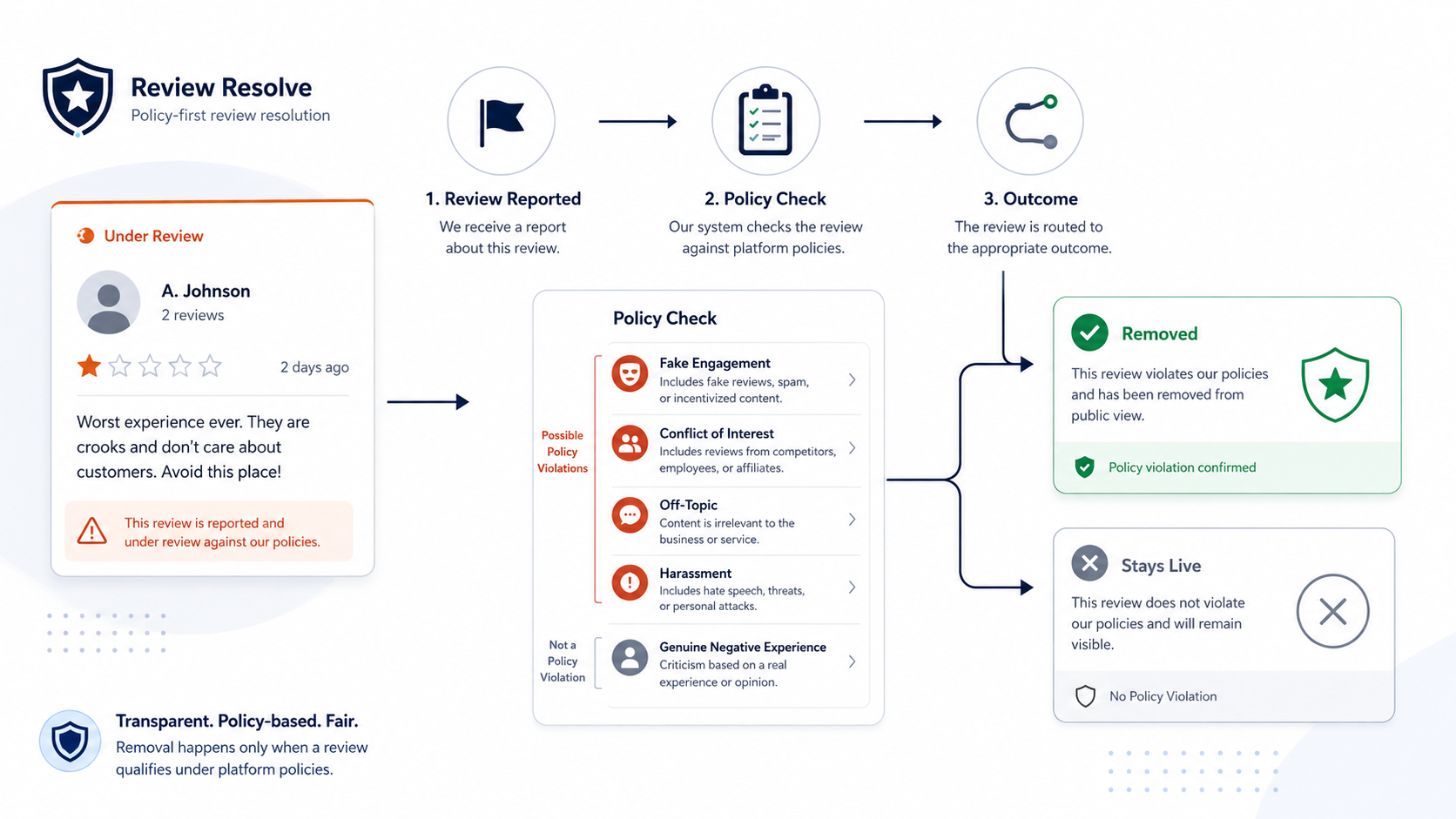
Can You Get a Google Review Removed?
Yes — some Google reviews can be removed, but only when Google determines that the review violates its content policies.
A business cannot remove a review simply because it is negative, inaccurate from the business’s perspective, or damaging to its rating.
The real question is:
Does the review violate Google’s policies?
Google allows businesses to report reviews they believe violate its policies and currently provides a one-time appeal option for eligible reviews that are not removed after the initial report.
If you already have a questionable review, see what makes a Google review eligible for removal.
Quick Answer: When Can a Google Review Be Removed?
A review may have grounds for removal when it involves issues such as:
- Fake engagement
- A review not based on a genuine experience
- Certain conflicts of interest
- Competitor manipulation
- Off-topic content
- Harassment
- Impersonation
- Misrepresentation
- Rating manipulation
- Certain prohibited or restricted content
Google’s Maps policies say reviews should reflect genuine experiences and prohibit fake engagement, rating manipulation, certain conflicts of interest, and other misleading or abusive content.
A legitimate negative customer review, however, may remain live even when the business strongly disagrees with it.
Can a Business Delete a Google Review?
No.
Businesses do not have a delete button for customer reviews.
Instead, you can report a review to Google if you believe it violates Google’s policies.
Google then evaluates the review and decides whether it should remain live or be removed.
That means no legitimate review-removal company controls the final decision.
Google does.
What Types of Google Reviews May Be Removed?
1. Fake Reviews
Google prohibits fake engagement.
That includes content that is not based on a real experience or does not accurately represent the business or location being reviewed.
Potential warning signs include:
- No identifiable customer interaction
- Details that do not match your business
- Reviews appearing from suspicious accounts
- Coordinated review activity
- Multiple reviews posted to manipulate a rating
If you suspect a review may be fake, read How to Spot a Fake Google Review.
2. Reviews From Competitors or Other Conflicted Parties
Google prohibits certain biased reviews and identifies conflicts of interest as a form of rating manipulation.
Google’s current policy says a conflict of interest can include:
- Current or former employment
- Contractual relationships
- Consulting relationships
- Industry competitors
- Certain personal or professional affiliations
If you believe the reviewer has a conflict of interest, preserve evidence of that relationship before challenging the review.
3. Reviews That Do Not Reflect a Genuine Experience
Reviews should represent an actual experience with a place or business.
A review may deserve closer evaluation when it:
- Describes services you do not provide
- Names employees who never worked there
- Refers to another business
- Describes an interaction your records show could not have occurred
- Appears unrelated to any genuine customer experience
Google’s Maps policies emphasize real experiences and prohibit deliberately fake content.
4. Off-Topic Reviews
Google prohibits certain content that is unrelated to an experience at the specific business or location.
Examples can include:
- General political commentary
- Social commentary unrelated to the business
- Personal rants unrelated to a customer interaction
- Content about another company or location
Google specifically says Maps content should be based on an experience at the relevant location.
5. Harassment, Threats, or Other Prohibited Content
Google’s Maps policies also restrict various forms of harmful or abusive content.
A review may warrant evaluation if it contains:
- Threats
- Harassment
- Certain personal attacks
- Prohibited personal information
- Other restricted content
A harsh review is not automatically harassment.
The actual language and circumstances matter.
6. Rating Manipulation
Google prohibits attempts to manipulate a business’s star rating through fake or misleading activity.
That can include coordinated campaigns intended to artificially raise or lower a business’s rating.
Examples might include:
- Review bombing
- Coordinated fake reviews
- Multiple accounts controlled by the same person
- Incentivized reviews
- Competitor-driven review campaigns
What Reviews Usually Cannot Be Removed?
This distinction is important.
A Real Customer Who Had a Bad Experience
If someone genuinely interacted with your business and disliked the experience, their negative opinion may remain.
A Review You Disagree With
Businesses and customers often remember situations differently.
Disagreement alone is not a policy violation.
A One-Star Rating
A 1-star rating by itself does not qualify for removal.
A Harsh Opinion
Statements such as:
- “Terrible service”
- “Too expensive”
- “Would not recommend”
- “Very disappointed”
may represent legitimate customer opinions.
A Review You Cannot Immediately Identify
Not recognizing the reviewer’s Google display name is useful context, but it does not prove the review is fake.
Customers may use:
- Nicknames
- Spouse accounts
- Different surnames
- Personal Google account names unrelated to the transaction
The strongest cases usually involve multiple pieces of evidence.
How Do You Report a Google Review for Removal?
Google provides a Reviews Management Tool for businesses.
The current process generally involves:
Step 1: Select Your Business
Choose the Google Business Profile associated with the review.
Step 2: Find the Review
Locate the review you believe violates policy.
Step 3: Report It
Select the reason that most accurately describes the policy issue.
Google gives examples such as spam or profanity among the available reporting reasons.
Step 4: Wait for Google’s Decision
Google evaluates the report.
The review may be:
- Removed
- Left live
- Pending review
Google controls both the decision and timing.
What Happens If Google Rejects Your Removal Request?
An initial rejection does not always end the process.
Google currently allows businesses to submit a one-time appeal for eligible reported reviews.
The appeal process lets Google reconsider the review after the initial decision.
That does not mean the review will necessarily be removed.
Google still makes the final determination.
How Should You Prepare Before Reporting a Review?
Do not just report a review because it looks suspicious.
Document it first.
Save:
- Screenshot of the review
- Reviewer name
- Reviewer profile
- Review date
- Star rating
- Full review text
Then check your own records.
Look at:
- CRM records
- Reservations
- Appointments
- Invoices
- Orders
- Call logs
- Support records
Ask:
Can we identify a genuine interaction corresponding to this review?
Then identify the specific policy concern.
For example:
Possible fake engagement
is much more useful than:
“We don’t like this review.”
Should You Respond While Trying to Get a Review Removed?
In many situations, yes.
Remember that prospective customers may see the review while the removal process is underway.
A calm response can demonstrate professionalism.
For a review you cannot identify, language like this can work:
We take feedback seriously, but we have been unable to identify an experience matching the details in this review. We would appreciate the opportunity to learn more. Please contact our team directly so we can better understand your concerns.
Avoid:
- Public accusations
- Threats
- Revealing private information
- Arguing line by line
- Becoming defensive
Your response is often written as much for future customers as it is for the reviewer.
How Long Does Google Review Removal Take?
There is no guaranteed timeframe.
Some decisions happen relatively quickly.
Others take longer, particularly when:
- The initial request is denied
- An appeal is required
- The policy issue is complicated
- Additional review is necessary
This is one reason Review Resolve does not promise a guaranteed removal date.
Our model is based on the outcome:
If the review stays live, you don't pay a removal fee.
See exactly how our review removal process works.
Can You Pay Google to Remove a Review?
No legitimate Google process allows a business to simply pay Google to remove a negative review.
Google removes content based on policy violations, not because a business wants the review gone.
You should also be cautious of companies claiming they can:
- Delete any Google review
- Guarantee every review will disappear
- Control Google's decision
- Remove legitimate criticism on demand
The appropriate approach is policy-based review evaluation and challenge.
Can You Remove a Google Review Yourself?
Yes.
Businesses can report suspected policy violations directly to Google.
You do not have to hire Review Resolve or any other company.
Professional assistance may make sense when you want help with:
- Evaluating the review
- Identifying potential policy violations
- Organizing documentation
- Managing multiple reviews
- Prioritizing reviews
- Handling the removal process
Our goal is not to make Google's process mysterious.
It is to make the analysis and management easier.
What If the Review Comes Back After Being Removed?
In some situations, online content can reappear or require additional attention.
If that occurs, the review should be reevaluated based on its current status and the circumstances surrounding the removal.
The important point is not to assume that a previous removal guarantees permanent removal in every situation.
How Much Can Removing a 1-Star Review Change Your Rating?
Potentially quite a bit.
It depends on:
- Your total number of reviews
- Your existing rating
- The star rating of the review
Smaller review profiles are generally affected more dramatically by individual ratings.
For example:
10 five-star reviews + one 1-star review
produces a mathematical average of approximately:
4.6 ★
For a deeper breakdown, read How One 1-Star Google Review Changes Your Rating.
Or use the free Google Review Rating Calculator to enter your actual review breakdown.
You can see:
- Your current calculated rating
- The impact of selected reviews
- A hypothetical rating if selected reviews were removed
- How many additional 5-star reviews it could take to reach a similar rating
No signup is required.
How Do You Know If Your Review Actually Qualifies?
Start with one question:
What specific Google policy does this review appear to violate?
Then look for evidence.
Ask:
Was there a genuine customer experience?
If not, fake engagement may be relevant.
Is there a conflict of interest?
Look for employee, competitor, vendor, or other relationships.
Is the review actually about your business?
If not, off-topic content may apply.
Is there prohibited content?
Evaluate harassment, impersonation, personal information, or other restricted material.
Can you document the issue?
Evidence makes the analysis stronger.
For a more detailed breakdown, read What Makes a Google Review Eligible for Removal? or visit What Reviews Qualify?.
How Much Does Google Review Removal Cost?
Review Resolve uses transparent, results-based pricing.
1–10 Reviews
$800 per successful removal
11–24 Reviews
$750 per successful removal
25+ Reviews
$700 per successful removal
There is:
- No upfront removal payment
- No monthly retainer
- No fee for reviews that remain live
See full Google review removal pricing.
Frequently Asked Questions
Can Google reviews be removed?
Yes. Google may remove reviews that violate its Maps content policies. Businesses can report suspected policy violations for evaluation.
Can a business delete a Google review?
No. Businesses cannot directly delete customer reviews. They can report reviews to Google, which decides whether removal is appropriate.
Can you remove a fake Google review?
Potentially. Google prohibits fake engagement and reviews that do not represent genuine experiences.
Can a competitor's review be removed?
Potentially. Google identifies certain conflicts of interest, including industry competitors, as prohibited biased-review activity.
Can a former employee review be removed?
Potentially. Google's policy says conflicts of interest may include current or former employment. The facts and circumstances of the review still matter.
Can a legitimate 1-star review be removed?
Not simply because it is one star. A genuine negative review may remain if it does not violate Google's policies.
What if Google rejects my removal request?
Google currently provides a one-time appeal option for eligible reviews that were reported but not removed.
How long does Google review removal take?
There is no guaranteed timeframe. Timing depends on Google's review process, the type of violation, and whether additional review or appeal is necessary.
Can I report a review myself?
Yes. Google provides businesses with tools to report reviews they believe violate policy.
How much does Review Resolve charge?
Review Resolve charges based on the number of reviews being pursued:
1–10 reviews: $800 per successful removal 11–24 reviews: $750 per successful removal 25+ reviews: $700 per successful removal
You do not pay an upfront removal fee.
Want to Know If Your Review Can Be Removed?
The first step is not paying someone to try.
It is determining whether the review may actually have legitimate grounds for removal.
Review Resolve will analyze the review for free.